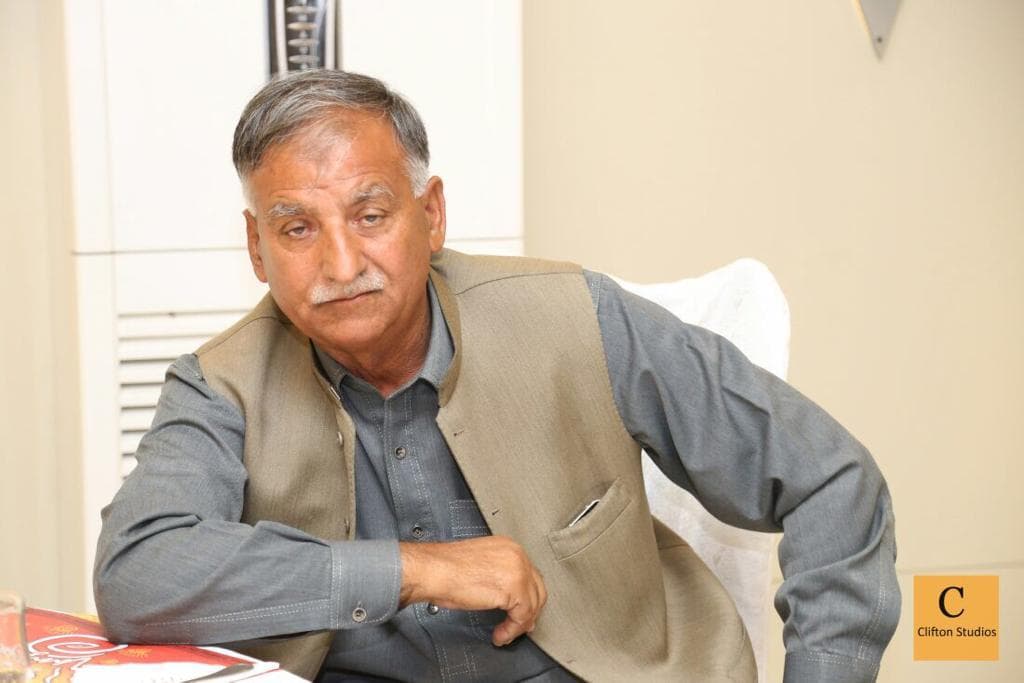
Abdur Rasheed Khan of Sultanwas, Buner
The complete account of Abdur Rasheed Khan’s civilian resistance, the Sultanwas Qaumi Lashkar, the destruction of the White House, national recognition and post-war peace-building.
Organising the Sultanwas Qaumi Lashkar
As militant combatants established an operational base in Sultanwas, traditional Pashtun leadership recognised that the threat extended far beyond physical occupation. Local land rights, village decision-making, family security and established customs were all at risk.
While intimidation forced many people into silence, Abdur Rasheed Khan emerged as one of the principal organisers of the local qaumi lashkar , a traditional civilian militia formed by community volunteers.
Local volunteers established defensive positions to watch key routes and protect residential areas.
Entry roads and village approaches were monitored to slow militant movement and gather information.
Residents defended family compounds using basic personal weapons and improvised local positions.
The resistance generated valuable knowledge about militant locations before the military operation.
The imbalance in firepower was severe. Villagers relied largely on personal rifles, while insurgents carried rocket-propelled grenades, heavy automatic weapons and battlefield equipment. The civilian defence was eventually overwhelmed, but its political and strategic importance remained significant.
The resistance delayed the militants’ consolidation, demonstrated that the occupation lacked genuine local consent and helped state security forces better understand the situation before Operation Black Thunderstorm .
The “White House” of Sultanwas
At the centre of Abdur Rasheed Khan’s story stood a highly recognisable residence known locally as the White House or the Full Marble House of Sultanwas .
The multi-family residence was built using fine stone and smooth marble associated with the family’s local marble-processing enterprise.
Militants entered Sultanwas, targeted Abdur Rasheed Khan’s property and occupied the residence as a fortified command position.
The marble factory was raided, heavy equipment was taken and the residence became part of the contested battlefield.
After displacement, the family returned to find the 15-year-old house and generations of family possessions reduced to rubble.
The house was not destroyed simply because of its size or visibility. According to the account preserved by the family and community, it was deliberately targeted because of Abdur Rasheed Khan’s anti-militant leadership. After occupying the compound, insurgents used its structure and location for defensive purposes.
During the air strikes and ground fighting required to remove entrenched militants from Sultanwas, the building was caught in intense crossfire and completely destroyed.
The ruined White House became a physical symbol of the price paid by those who opposed the occupation. Its destruction linked private loss with public resistance and turned a family residence into part of Buner’s wider wartime memory.
The Connection with Jehan Zeb Khan
Sultanwas did not endure the crisis through the efforts of one person alone. Its resilience was supported by a broader network of elders, households and long-established village relationships.
Within this civic structure, Jehan Zeb Khan was another prominent elder and head of household in Sultanwas. His family, including his son Jalil Jan , represented a separate and distinct household within the village’s tribal and social organisation.
Associated with active civilian defence, leadership of the qaumi lashkar, public advocacy and post-war peace committees.
Associated with longstanding residential lineage, civic standing, post-war reconstruction and legal continuity.
Represented the immediate protection of village space, families and access routes during the occupation.
Represented the preservation of household identity, legal presence and long-term community structure after the conflict.
Together, these families illustrate two complementary forms of strength: immediate resistance during crisis and the quieter, long-term work of preserving community life after devastation.
Other elders and residents of Sultanwas also resisted the occupation. Their contributions should be understood within the village’s wider network of separate families and local leadership traditions.
National Recognition and Post-War Leadership
After security forces cleared Buner, Abdur Rasheed Khan returned to Sultanwas rather than permanently abandoning the village. He assisted returning families, helped coordinate damage assessments with civil authorities and supported the creation of local Aman Committees , or Peace Committees.
These committees were intended to strengthen local vigilance, rebuild confidence and prevent militant networks from regaining influence.
In recognition of his civil courage, loyalty to Pakistan and defence of his community, the President of Pakistan formally conferred upon Abdur Rasheed Khan the Tamgha-i-Shujaat , or Medal of Bravery, during the 2012 Civil National Awards.
The award recognised not only an act of bravery, but a sustained commitment to village, community and country.
A Legacy Built Beyond Stone
Abdur Rasheed Khan’s famous house no longer stands in its original form, but the meaning attached to it remains. The ruins of the White House became part of a larger story about how civilians in Buner responded to militant occupation.
His legacy rests on several connected roles: organiser of local resistance, defender of Sultanwas, victim of targeted destruction, advocate for returning residents and participant in post-conflict peace-building.
For future generations, the history of Abdur Rasheed Khan Sultanwas is not simply an account of war. It is a record of how leadership functions when formal systems are under pressure, how communities preserve dignity during displacement and how sacrifice can become part of a village’s shared identity.
This record forms part of the Sultanwas family and community archive.