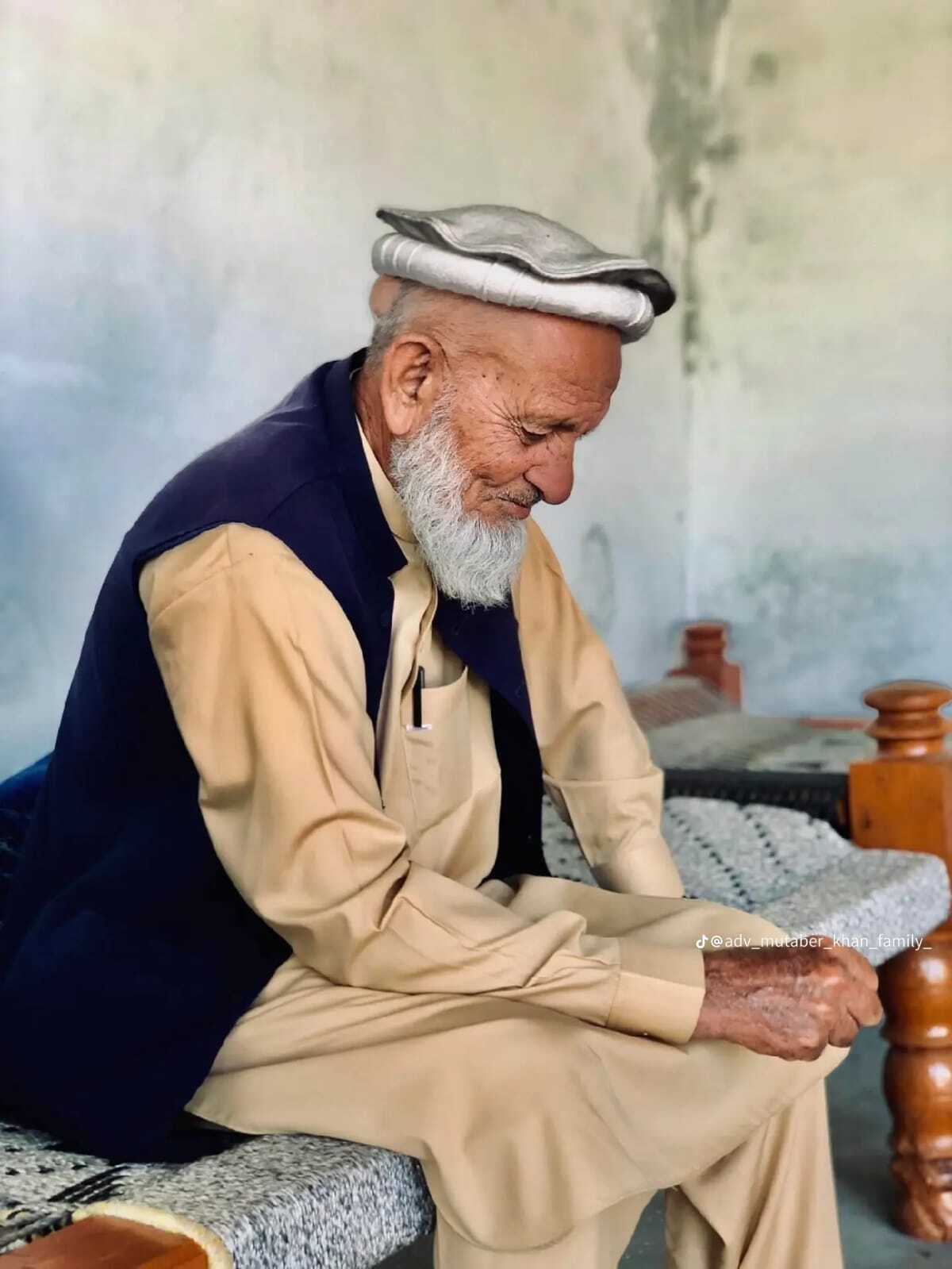
In the rugged terrain of Buner District, Khyber Pakhtunkhwa, the history of Village Sultanwas in Tehsil Gadezai is defined not only by combat, military operations or visible acts of resistance. It is also shaped by the quieter endurance of civilian elders who preserved family unity, ancestral identity and social continuity through war, displacement and rebuilding.
Among these respected community figures, Jehan Zeb Khan stands as a symbol of perseverance rooted in place. His legacy belongs to the long tradition of village elders whose authority did not depend on public office, military rank or national visibility, but on trust, lineage, land and service to the community.
Not every form of courage is expressed on a battlefield. Some of it is measured by the decision to preserve a community until it can return home.
A Pillar of Sultanwas
Located near the historical and spiritual landmark of Pir Baba, Sultanwas is a close-knit agricultural village shaped by deep family ties, ancestral landholding and traditional Pashtun systems of consultation and local governance.
Within that social structure, Jehan Zeb Khan represented the enduring role of the civilian elder: a long-standing head of household, guardian of family continuity and respected presence within the wider community of Gadezai.
Rooted authority
His standing came from family responsibility, ancestral presence and trust built over generations rather than from a formal government position.
Social cohesion
Elders such as Jehan Zeb Khan helped preserve relationships between families when physical displacement threatened to fragment the village.
Land and identity
In Sultanwas, ancestral property was more than an economic asset. It represented legal continuity, family memory and belonging.
Endurance through crisis
His role reflected the essential work of keeping displaced households connected to the idea of return and reconstruction.
War, Displacement and the Survival of Community
In 2009, the conflict in Buner transformed Sultanwas into a central operational hub for militant forces. The village became part of an intense military theatre, and the civilian population faced an existential crisis.
Artillery, airstrikes and ground fighting severely damaged homes across Sultanwas. More than 300 houses were affected, and local families were forced to leave for displacement camps and temporary accommodation in areas including Swabi, Mardan and Peshawar.
Homes reportedly damaged during the fighting in Sultanwas.
Major areas of displacement referenced in local accounts: Swabi, Mardan and Peshawar.
Shared objective that held the community together: return to ancestral land.
During displacement, the danger was not only physical loss. A scattered village could lose its internal relationships, legal memory, customary boundaries and commitment to return. Elders like Jehan Zeb Khan played a crucial role in maintaining social cohesion among families living away from Sultanwas.
Displaced households retained communication, mutual support and awareness of village affairs.
Temporary exile did not become permanent abandonment of family land or village belonging.
Community recovery depended on the collective decision to rebuild rather than disperse permanently.
Returning families rebuilt social networks, meeting spaces, legal presence and local institutions.
The Connection with Abdur Rasheed Khan
The resilience of Sultanwas rested on more than one form of leadership. Two complementary forms of leadership can be seen in the roles of the brothers Abdur Rasheed Khan and Jehan Zeb Khan.
Abdur Rasheed Khan
He was associated with public anti-Taliban leadership, organisation of local civilian defence, the destruction of his famous full-marble residence and later national recognition through the Tamgha-i-Shujaat.
Jehan Zeb Khan
He represented family roots, ancestral land stewardship, social continuity and the stability required for post-conflict recovery.
The two elders were brothers from the same family: Jehan Zeb Khan was the elder brother, and Abdur Rasheed Khan was the younger. Their leadership was complementary—Jehan Zeb Khan provided senior household continuity and ancestral stability, while Abdur Rasheed Khan became closely associated with public resistance, community defence and post-conflict reconstruction.
Together, they represent a dual structure of village resilience: one form visible in resistance and public defence, the other visible in continuity, memory, land and the rebuilding of ordinary life.
One form of leadership defended the village in crisis. The other ensured that the village still existed socially after the crisis had passed.
Ancestral Continuity and Contemporary Lineage
The enduring legacy of Jehan Zeb Khan is reflected in his family’s continued presence within the social, civil and legal fabric of District Buner.
Judicial records connected with the Peshawar High Court, Mingora Bench, also known as the Dar-ul-Qaza, Swat, document the family’s continuing legal residency in Village Sultanwas, Tehsil Gadezai.
His son, Jalil Jan, identified in formal records as Jalil Jan son of Jehan Zeb Khan, remains associated with Sultanwas and with the management of family and civic matters through local institutions, including the District Courts in Daggar and the High Court Sub-Registry.
What continuity means in Sultanwas
This continuity is significant because post-conflict recovery is rarely complete when it focuses only on roads and buildings. A village is truly restored when its families regain legal standing, social trust, property relationships and confidence in the future.
An Unsung Legacy
National histories often focus on military operations, decorated bravery and visible confrontation. Yet the long-term stability of north-western Pakistan also depends on civilian elders whose work is less dramatic but equally consequential.
Jehan Zeb Khan’s legacy lies in that quieter sphere. By helping preserve family unity through displacement, sustaining commitment to ancestral land and maintaining a household presence across generations, he contributed to the survival of Sultanwas as a living Pashtun community.
His story demonstrates that civilian leadership can be measured through endurance: remaining attached to place, rebuilding after loss, protecting lineage and keeping community memory intact.
Why his story matters
Through war, exile and reconstruction, Sultanwas remained connected to its ancestral foundations. Jehan Zeb Khan’s household forms part of that continuity: an unbroken link between land, lineage and the future of the village.